
Pr. Prosper Kompaoré
A vision that became a movement.
An academic, playwright, director and pioneer of Theatre for Development, Prosper Kompaoré has devoted his life to making theatre a space for dialogue, research and social transformation.
Discover his journey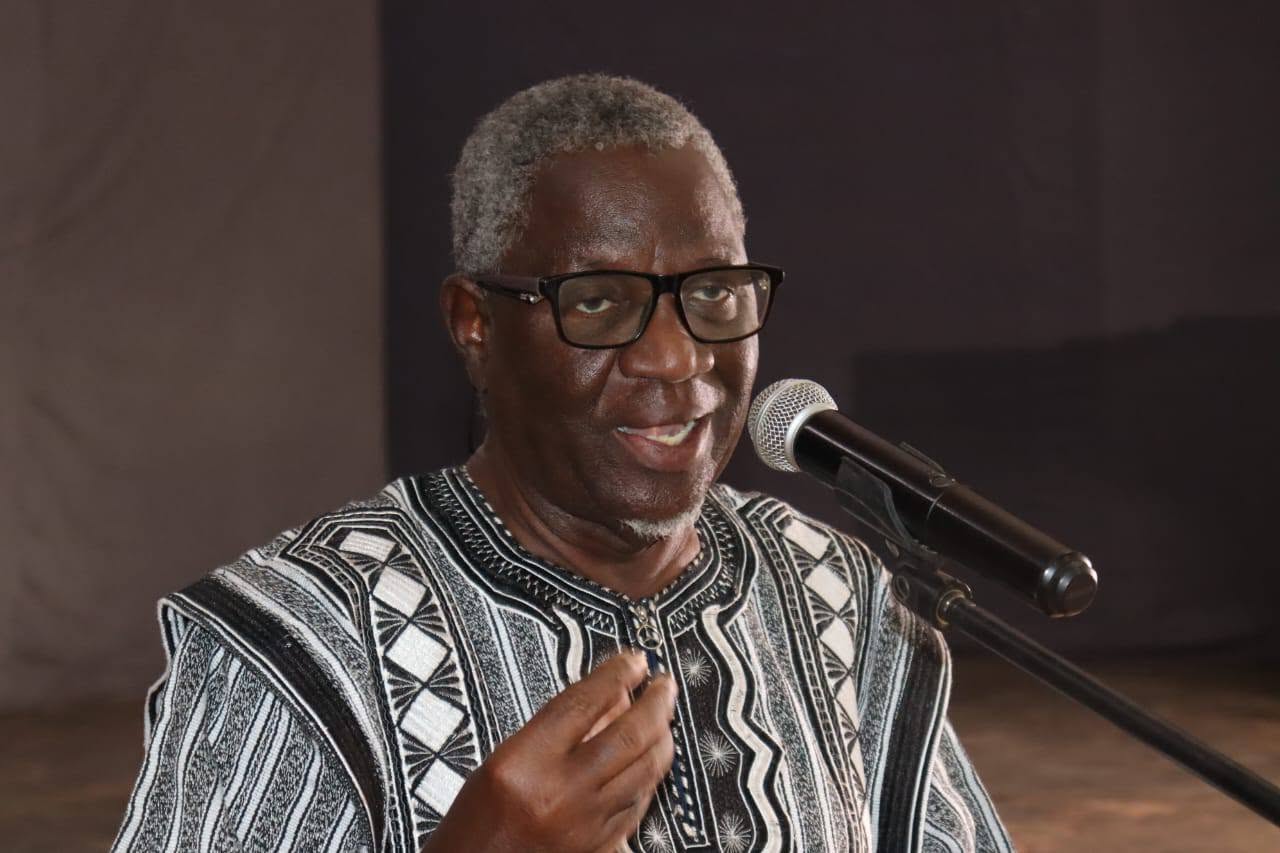
A life devoted to culture and development
For Prosper Kompaoré, theatre was never meant to entertain alone. It had to become a shared language, helping communities examine their realities, engage in dialogue and build their own responses to social challenges.
In 1978, together with a group of young students and friends, he founded the Amateurs du Théâtre Voltaïque, which became Atelier Théâtre Burkinabè in 1985. From the outset, the company pursued an ambitious vision: to build an African theatre deeply rooted in cultural realities while placing it at the service of awareness and social change.
Over the decades, this conviction became a method, an institution and a movement. It has inspired artistic creations, research, festivals, practitioner networks and several generations of committed artists.
Turning theatrical experience into a force for transformation, responsibility and transmission.
The stages of a vision taking shape
Prosper Kompaoré’s story is more than a succession of dates. It traces the gradual development of a conviction: that theatre can be a tool for expression, participation and social transformation.
From a troupe of passionate young people to a movement recognised beyond national borders, each stage deepened the same pursuit: bringing the stage closer to the realities experienced by communities.
 1978
Give theatre a purpose
On 18 June 1978, Prosper Kompaoré founded the Amateurs du Théâtre Voltaïque with a group of young students and friends. From the outset, their ambition went beyond entertainment: to contribute to the country’s development by raising awareness.
 1979–1981
Reaching rural communities
The troupe travelled through villages, presenting performances rooted in people’s everyday realities. Each performance was followed by a discussion, often held in a national language.
 1981–1983
Bringing urban realities to the stage
Building on its rural theatre experience, the troupe developed neighbourhood theatre, staging the challenges facing African cities: schooling, youth, alcoholism, exclusion and injustice.
 1983
Turning spectators into actors
ATB adopted the name Forum Theatre for a practice it had already been experimenting with in the field. A performance presents a problematic situation, after which audience members intervene to propose and test possible solutions.
The performance does not provide a ready-made answer. It creates the conditions for the community itself to explore pathways to change.
 1985
From ATV to Atelier Théâtre Burkinabè
The Amateurs du Théâtre Voltaïque became Atelier Théâtre Burkinabè, marking a new artistic and institutional stage.
 1988
Connecting experiences across borders
The celebration of ATB’s first ten years paved the way for the International Festival of Theatre for Development, encouraging exchanges among companies committed to social change.
 1994
Sowing seeds to multiply impact
Through the “Semailles” initiative, ATB supported the creation of autonomous companies led by former actor-trainers. The method moved beyond the institution itself and spread sustainably.
 1997–2002
Creating opportunities for young people
The creation of CASEO, the Forum Theatre Competition and CAPO gave new generations opportunities to discover the stage, develop their creativity and speak out on social issues.
 2005–2007
Deepening participation
ATB continued its research through Community Theatre and Trial Theatre. Communities became more deeply involved in creation, staging, debate and the formulation of concrete commitments.
 Today
A vision that continues to make a difference
Today, the Theatre School, productions, partner companies, publications and youth programmes carry this founding vision forward.
Prosper Kompaoré’s legacy does not live only in ATB’s archives. It lives on through the artists, trainers, researchers and communities who continue this experience.
From vision to major innovations
This historical journey leads into an artistic laboratory that profoundly transformed the relationship between the stage, audiences and communities.
Inventing a theatre that takes action
Under Prosper Kompaoré’s leadership, ATB established itself as a permanent laboratory. Each innovation pursued the same ambition: bringing artistic creation closer to lived realities and giving audiences an active role in the search for solutions.

From performance to participation
The research initiated by Prosper Kompaoré led ATB to progressively reshape the relationship between stage and audience. Performance became a space for dialogue where situations could be questioned, interventions made, arguments exchanged and alternative behaviours explored.
This approach never compromises artistic rigour. It brings together dramaturgy, acting, facilitation, oral traditions and a deep understanding of social contexts.
Innovation is not only about creating a new form. It is about inventing a new relationship between the work, the audience and society.
 Forum Theatre
A play presents a situation of deadlock, conflict or oppression. During the replay, audience members take the stage to propose and test alternative responses.
- Presentation of a problematic situation
- Intervention by the Joker
- Spect-actors take the stage
- Collective debate and search for solutions
 Community Theatre
Community members are not given an outside story. They take part in the research, writing, performance and public presentation of their own realities.
- Gathering community voices
- Creation with different social groups
- Public performance and feedback
- Engagement of local stakeholders
 Trial Theatre
After the performance, the audience divides into prosecution and defence. Arguments are confronted, clarified and then submitted to collective deliberation.
- Staging a trial
- Prosecution and defence arguments
- Technical insight from legal professionals
- Verdict delivered by the audience
 Culturally rooted aesthetics
Culturally rooted dramaturgy
Artistic research draws on oral traditions, languages, symbols and forms of participation rooted in African societies.
- Celebrating local cultural imaginaries
- Dialogue between tradition and modernity
- Forms of expression accessible to communities
- Artistic rigour and social relevance
One philosophy: opening up dialogue
These theatrical forms differ in their construction, but all rest on the same conviction: lasting change cannot be imposed from outside. It must be built with the people concerned.
From Burkina Faso to the world
By training companies, welcoming researchers, taking part in festivals and working with international institutions, Prosper Kompaoré and ATB helped share the experience of Theatre for Development far beyond Burkina Faso.
An experience born in Ouagadougou became a shared language among artists, researchers and development practitioners across several continents.
West Africa
Niger, Senegal, Côte d’Ivoire, Mali, Guinea, Togo and Benin.
Central, East and Southern Africa
Chad, Cameroon, Uganda, Sierra Leone and South Africa.
Europe and the Americas
Belgium, France, Great Britain and Brazil, through tours, training and collaborations.
Indian Ocean
Madagascar and Mauritius, through the transmission of Theatre for Development methods.

Training artists, connecting experiences, building networks
Prosper Kompaoré’s international reach is rooted less in one-way dissemination than in exchange. Each mission becomes an opportunity to learn, share knowledge and adapt practices to local cultural realities.
Turn experience into expertise
For Prosper Kompaoré, theatrical practice was never meant to remain confined to the moment of performance. It had to be analysed, documented, examined through research and passed on to future generations.
A body of work at the crossroads of art, education and development
The publications, journals, plays and research produced around ATB preserve lessons learned in the field. They provide artists, researchers, students and development practitioners with tools to understand and adapt Theatre for Development to new contexts.
An experience that is not documented risks disappearing. An experience that is transmitted becomes a collective heritage.
Faire du théâtre pour développer
Faire du théâtre pour développer
A reference work devoted to the design, facilitation and evaluation of Theatre for Development practices.
Les voix du silence
Les voix du silence
An emblematic work associated with Prosper Kompaoré’s artistic journey and the international reach of Atelier Théâtre Burkinabè.
Mudança de cena
Mudança de cena
A publication reflecting the international circulation of experiences, methods and ideas developed through Theatre for Development.
Enjeux de Scène
Enjeux de Scène
A journal devoted to analysing the performing arts, documenting field practices and reflecting on transformations in African theatre.
Read the journalThinking rooted in field experience
The work developed around Prosper Kompaoré and ATB continually brings together artistic creation, popular participation and social effectiveness.
African dramaturgical aesthetics
Explore forms of staging rooted in the traditions, languages, symbols and modes of participation specific to African societies.
Audience participation
Explore ways of making the audience an active participant in the performance, the debate and the search for solutions to the situations presented.
Social change
Understand how theatre can support awareness-raising, behaviour change, community mobilisation and civic engagement.
Documentation and transmission
Document experiences, produce educational resources and pass methods on to artists, trainers, NGOs and researchers.
Resources to learn, teach and extend research
ATB publications are intended for artists, students, academics, theatre companies and organisations seeking to use theatre as a tool for dialogue and social transformation.
A body of work recognised
The distinctions received by Atelier Théâtre Burkinabè reflect the artistic quality and social reach of a collective body of work developed under Prosper Kompaoré’s leadership.
This selection presents institutional distinctions received by ATB. The founder’s personal distinctions may be added once they have been documented and validated.

First Prize for Francophone Live Performance
Recognition received at the Rencontres francophones du spectacle vivant.
ATB distinctionFirst Prize at the National Theatre Grand Prix
Award won with the play “L’Or du diable”.
ATB distinctionFirst Prize at FESTHEF
Recognition of ATB’s artistic reach on the regional theatre scene.
ATB distinctionBest Direction and Best Awareness-Raising Company
Two distinctions received at the first edition of the Lompolo Awards.
ATB distinctionBest Theatre Company
A distinction confirming ATB’s place among Burkina Faso’s major theatre institutions.
ATB distinctionThe most lasting recognition is the impact that is passed on
Awards honour a body of work. But the true measure of its influence lies in the artists trained, the companies created, the methods shared and the communities that have reclaimed their voice.
His legacy is not simply preserved. It is passed on.
Prosper Kompaoré’s legacy can be measured both in the works and institutions he helped build and in the people to whom he passed on a method, a standard of excellence and a sense of responsibility.

Building an institution capable of carrying the journey forward
Transmission is not only about teaching acting techniques or facilitation methods. It means preparing other artists to research, create, train, lead and adapt theatre tools to the realities of their own time.
This philosophy explains the importance given to the Theatre School, company training, professional encounters, publications and the progressive empowerment of teams.
A founder’s true legacy becomes visible when the work can continue to grow beyond the founder’s own presence.
Develop well-rounded artists
Pass on acting, directing, physical expression, dramaturgy and Theatre for Development methods.
- Theatre School
- Workshops and training
- Training of trainers
- Support for young artists
Help new initiatives emerge
Support autonomous companies and build networks capable of adapting methods to local contexts.
- Operation Semailles
- Partner companies
- Professional networks
- International cooperation
Prepare continuity
Enable teams to master every stage of creation, production, distribution and transmission.
- Team autonomy
- Transfer of responsibilities
- Documentation of methods
- Institutional sustainability
A school, a network, a new generation
ATB has trained and supported artists from different generations. Some have become actors, directors, facilitators, trainers or leaders of their own companies.
This chain of transmission allows the founding vision to renew itself as it encounters new social, artistic and technological realities.
Each generation receives a method, but also the freedom and responsibility to develop it further.

The Theatre School
Build strong foundations and develop genuine artistic awareness.

Workshops and productions
Experiment with new forms and bring artistic creation into dialogue with social realities.

Trainers and partner companies
Share experience with other artists, institutions and communities.

The next generation
Carry ATB’s vision into new contexts and through new artistic languages.
A memory in motion
From rehearsals to institutional encounters, from stages to training spaces, these images bear witness to a history built collectively.
“Cultural struggle requires constant energy, because nothing can ever be taken for granted.”
From a company founded by a few passionate young people to a recognised institution, ATB’s history shows what a rooted, patient and shared vision can accomplish.
Discover ATB’s history